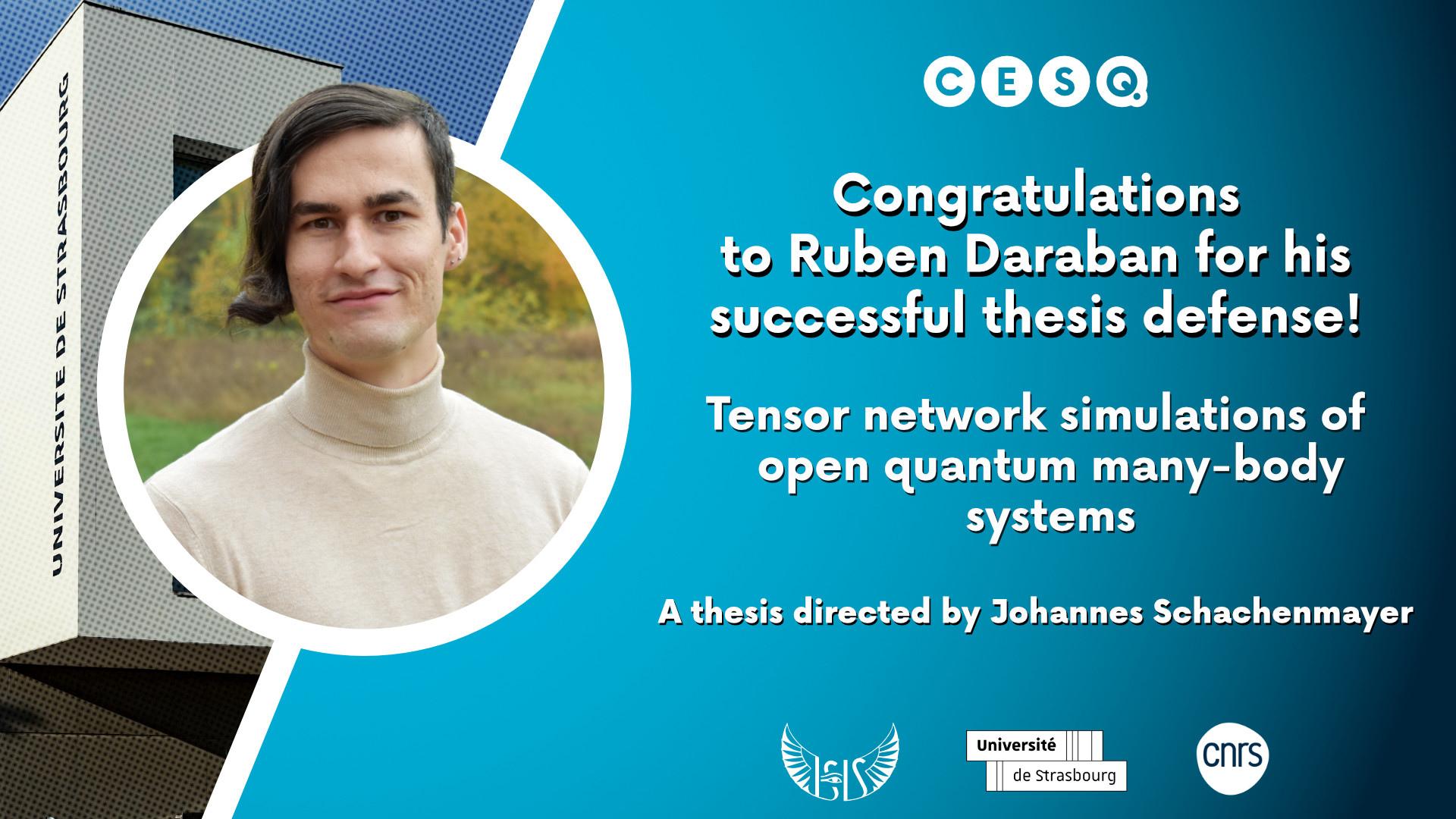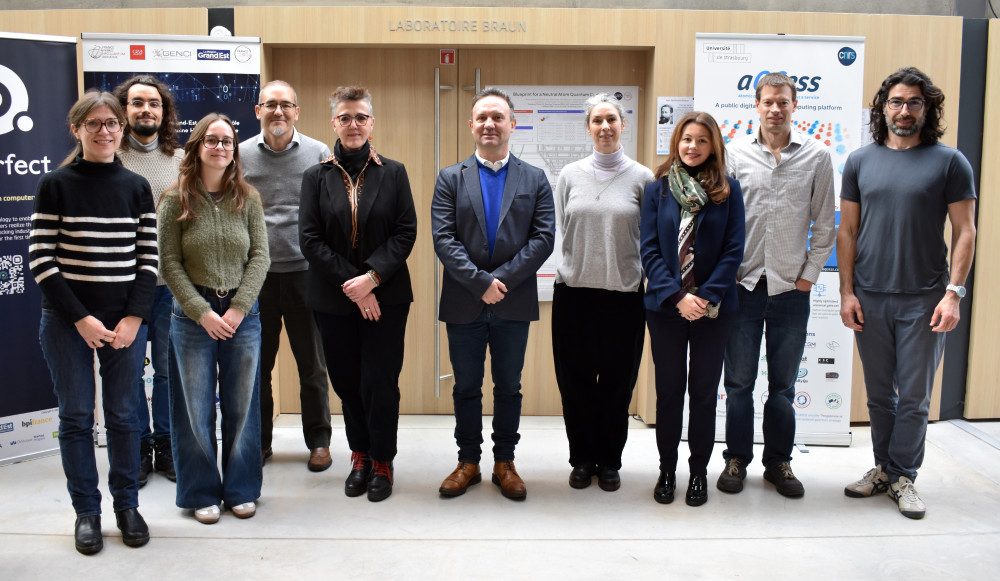
We are pleased to congratulate Ruben D. on the successful defense of his PhD thesis, “Tensor network simulations of open quantum many-body systems”, supervised by Johannes Schachenmayer.
Real quantum systems are noisy because they interact with their environment. In his thesis, Ruben used classical computers to simulate such systems, relying on matrix product states and quantum trajectories. He showed that:
- Noisy quantum circuits: a new and inexpensive unraveling algorithm (NUMU) speeds up simulations of up to 100 qubits.
- Spin chains with a dark state (a state protected from dissipation): many-body effects lead to a logarithmically slow decay following a universal law, a result obtained with collaborators at Michigan State University and the University of Amsterdam.
- A minimal model of polaritonic chemistry: disorder plays a key role that semi-classical approaches miss.
To learn more, read Ruben’s latest article, “Universal dynamics from a single-particle dark state”: https://lnkd.in/edGZ2EiJ
At CESQ, Ruben developed and strengthened skills that will be crucial for his career, particularly in distributed computing infrastructure, tensor network algorithms, computational physics and programming in Julia.
Ruben arrived in Strasbourg in 2021 to complete a master’s degree in Condensed Matter Nanophysics at the Université de Strasbourg, before joining CESQ in 2023. He will now stay with us to finish his project.
Congratulations again, Ruben!