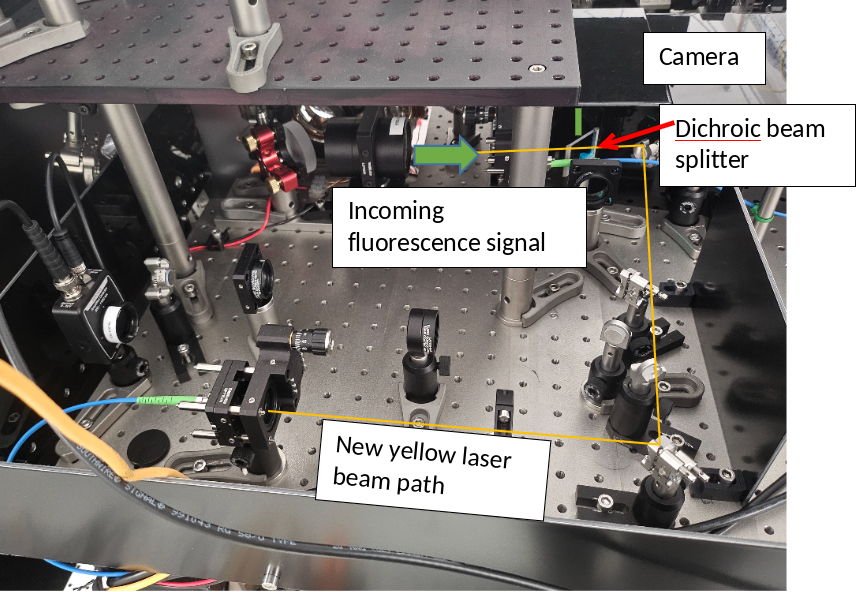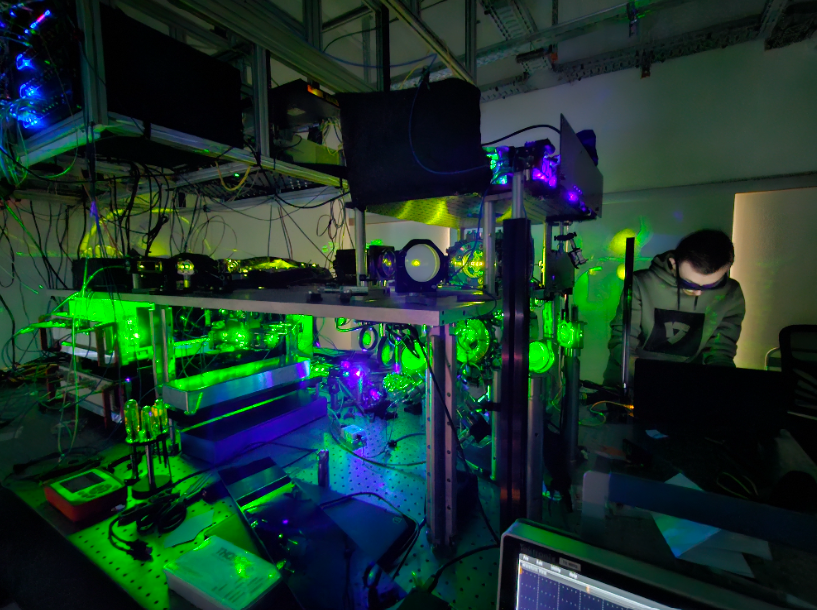
To perform computing tasks on a quantum platform, qubits must remain stable for at least a few microseconds, remaining in the same energy level. In order to fulfill the need for qubits stability on its quantum computer, the aQCess team has introduced a 578 nm Toptica laser to the system that can drive atoms into a “forbidden” excited state. The transition to this forbidden state is extremely unlikely, up to a billion times weaker than an ordinary allowed transition. In turn, that weakness is what allows a high degree of control and stability. As a result, qubits can remain stable for 10s of seconds, making them suitable for running computing tasks.
The team is also adjusting the platform’s other lasers, each of which serves a specific task. The addition of a new beam path of the green laser, used for fluorescence imaging, allows for better imaging of single atoms. A repumping beam, used for further control of atomic transitions, has also been added to the platform.