
CESQ connects to atomic clocks via the REFIMEVE network

05.05.26

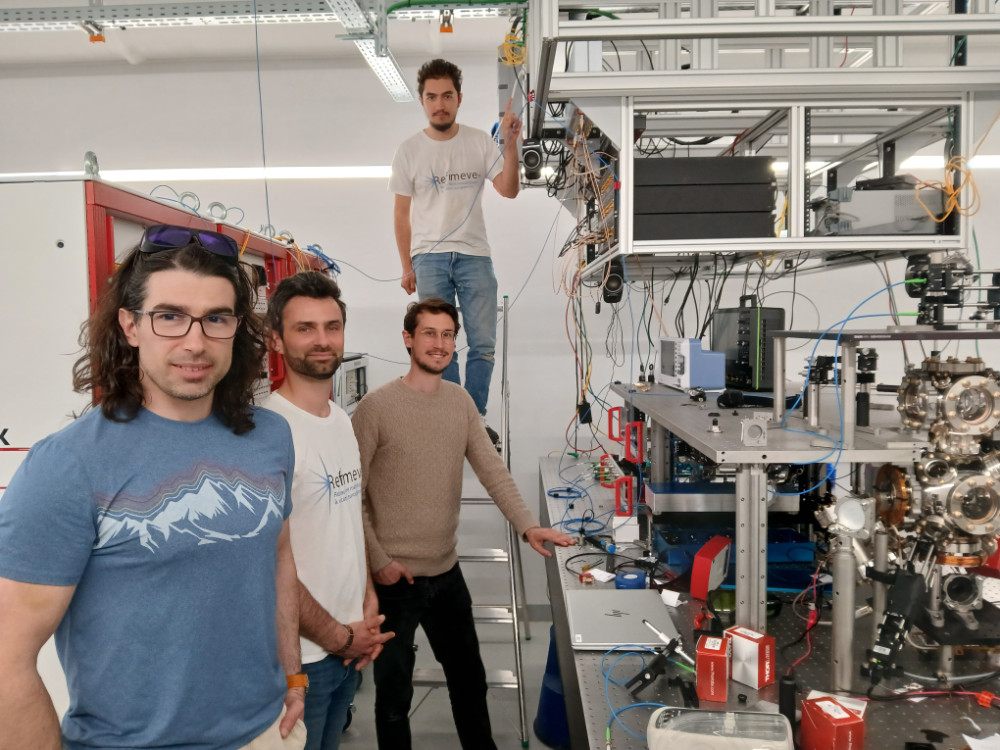
Since 21 April, the CESQ1 has been connected to the REFIMEVE research infrastructure network, managed by the Laboratory of Laser Physics2 and the Time and Space Laboratory (LTE)3, which distributes the most accurate time and frequency references available via fibre optics from the LTE’s atomic clocks. This distribution is carried out without any degradation in the performance of the signals generated at the LTE, unlike what might be achieved by GPS or GALILEO, which are 10,000 times less accurate than the transfer via REFIMEVE.

This connection, made possible via the RENATER and OSIRIS fibre networks, strengthens CESQ’s research capabilities in quantum science and technology. It directly benefits:

  • Quantum sensors, which require an absolute, accurate and traceable reference
  • Quantum computers, whose lasers gain in stability thanks to reduced time drift
  • Quantum communications, which rely on shared time synchronisation between laboratories.

The connection to the LTE’s atomic clocks also opens up research opportunities in fundamental physics, and in other fields such as atmospheric sciences and astrophysics.

Ultimately, REFIMEVE will facilitate the comparison of measurements from the CESQ with those from other European laboratories thanks to its connection to networks in Germany, Italy and the United Kingdom, and soon to around twenty European countries through the European research infrastructure project FOREST.
  1. Isis, Unistra, CNRS ↩︎
  2. CNRS, Sorbonne University Paris-Nord ↩︎
  3. Paris Observatory-PSL, CNRS, Sorbonne University, University of Lille, and the National Metrology and Testing Laboratory ↩︎

VivaTech and the Région Grand Est visit CESQ

05.05.26

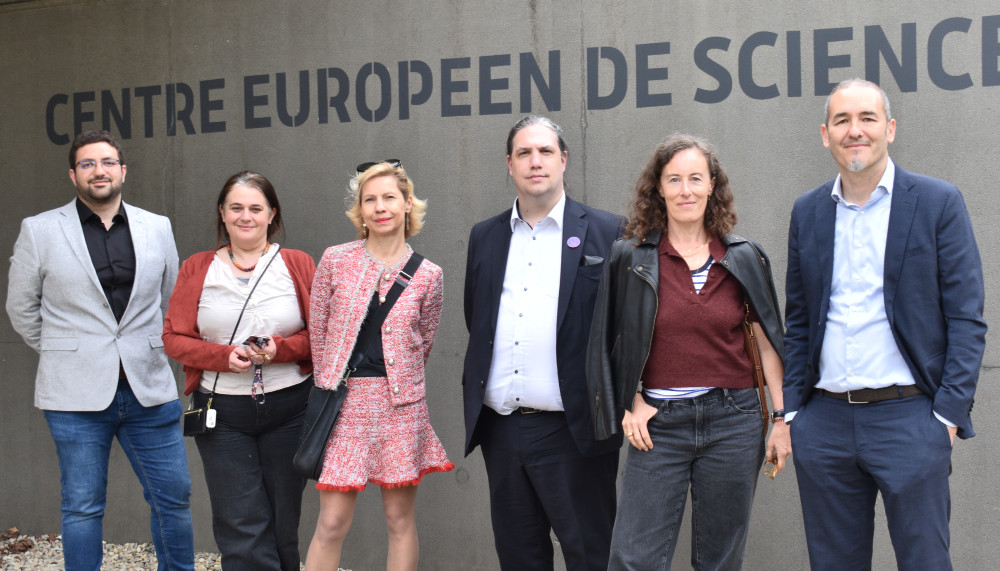
On Tuesday 28 April, the European Center for Quantum Sciences (CESQ) had the pleasure to welcome a delegation from VivaTech for a visit of our center organised by the Région Grand Est.

This visit was an opportunity for Guido Pupillo to present the quantum ecosystems that CESQ is actively helping to shape, at the Strasbourg, Grand Est and Upper Rhine levels, through initiatives such as MaQuEst and UpQuantVal, in partnership with the University of Strasbourg, CNRS, the Eurométropole de Strasbourg, the Région Grand Est and Interreg Rhin Supérieur. He also shared an overview of where quantum computing stands today and where it is headed.

Shannon Whitlock gave a tour of the aQCess platform, an open quantum computing infrastructure designed to be accessible to a wide range of scientific and industrial communities. Anna Whitlock and Guido Masella, from QPerfect, a startup hosted at our center, also presented their company and ongoing projects.

The interest shown by one of Europe’s leading tech events sends a strong signal: quantum computing is gaining momentum. As Guido Pupillo put it: “Beyond the hype, quantum computing is a real and tangible promise.”

A warm thank you to Julie Lamandé and Guillaume Chapuisat from VivaTech, and to Cécile Marter from the Région Grand Est for this great visit.