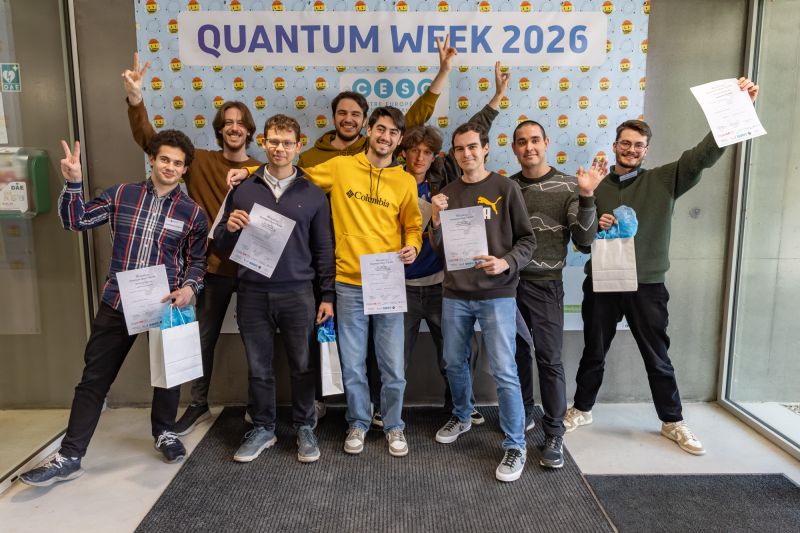
During two days, the CESQ hall was taken over by ranges of tables of students collaborating together in a relaxed and studious atmosphere. The students worked impassively while the CESQ researchers, impressed by the spectacle, tried not to disrupt the students’ creative flow. The whiteboards separating the tables quickly covered up in green, red and blue equations.
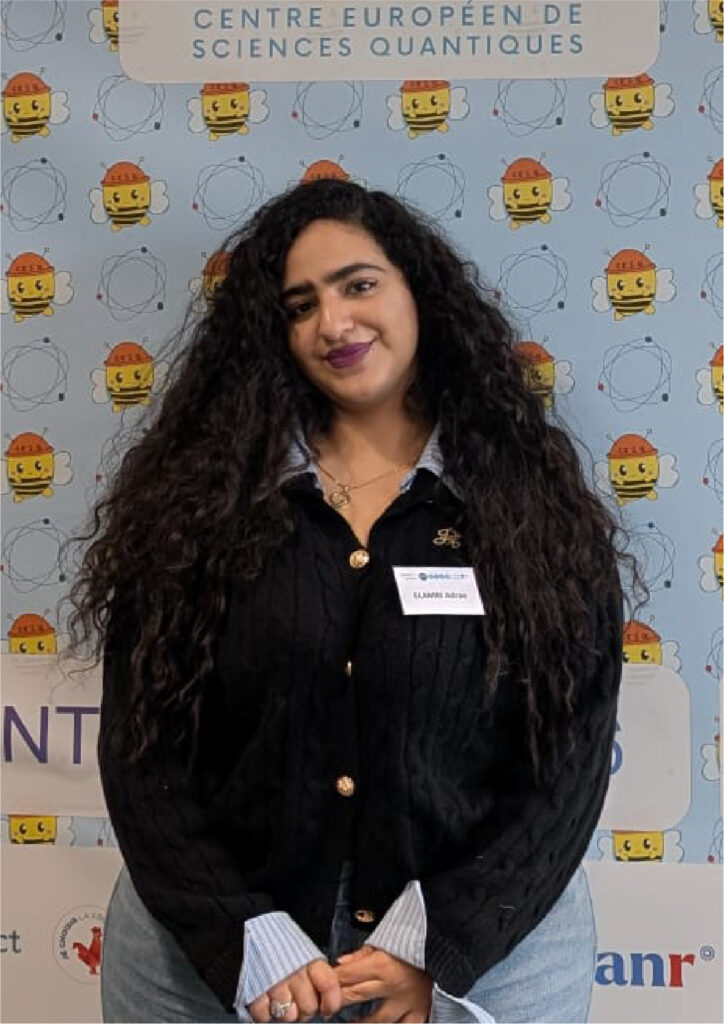
In between whiteboards, at table n3, Adrae is working on how to perform the quantum measurement of the free fall acceleration of an anti-atom. She is a 21-year-old Erasmus student in Brescia, Italy, studying electronics, photonics and microwave engineering.
She has already faced many hackathons during her Bachelor but this is the first time she faces such a challenge. She explains that it’s not just about solving equations, but facing a new problem, and addressing it from different angles.
Adrae can count on a very diverse team composed of students from photonics and microwave engineering, as well as from quantum and computer science. With these broad backgrounds and with the help of their mentor, each of them contributes on the part they are more familiar with.
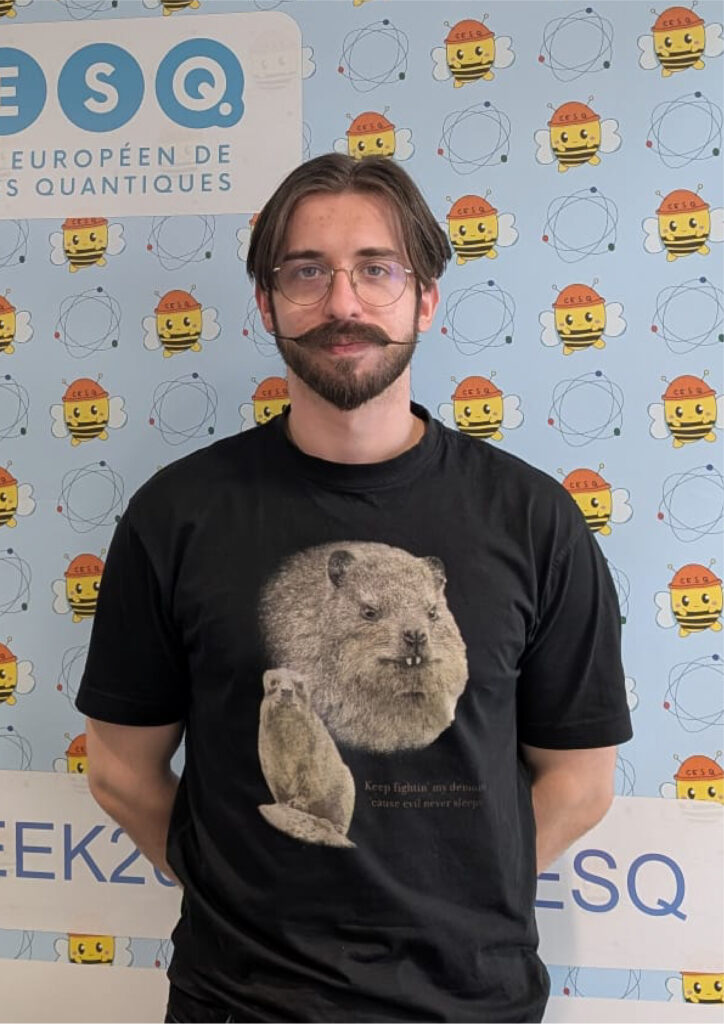
For Pijus at table n7, a student in quantum sciences from the university of Copenhagen this is also a new experience compared to the computer science hackathons that he attended to during his bachelor in software engineering.
“It’s a little bit different from computer science hackathons because usually people gather with let’s say the knowledge of how to build stuff and then it’s just 48 hours and they’re just constructing”. “Here it’s more exploratory”.
Pijus learned about this hackathon in Strasbourg as a participant of the DigiQ network, which he describes as “a network of universities where students can collaborate and visit different research institutions and learn about how each institution is working”.
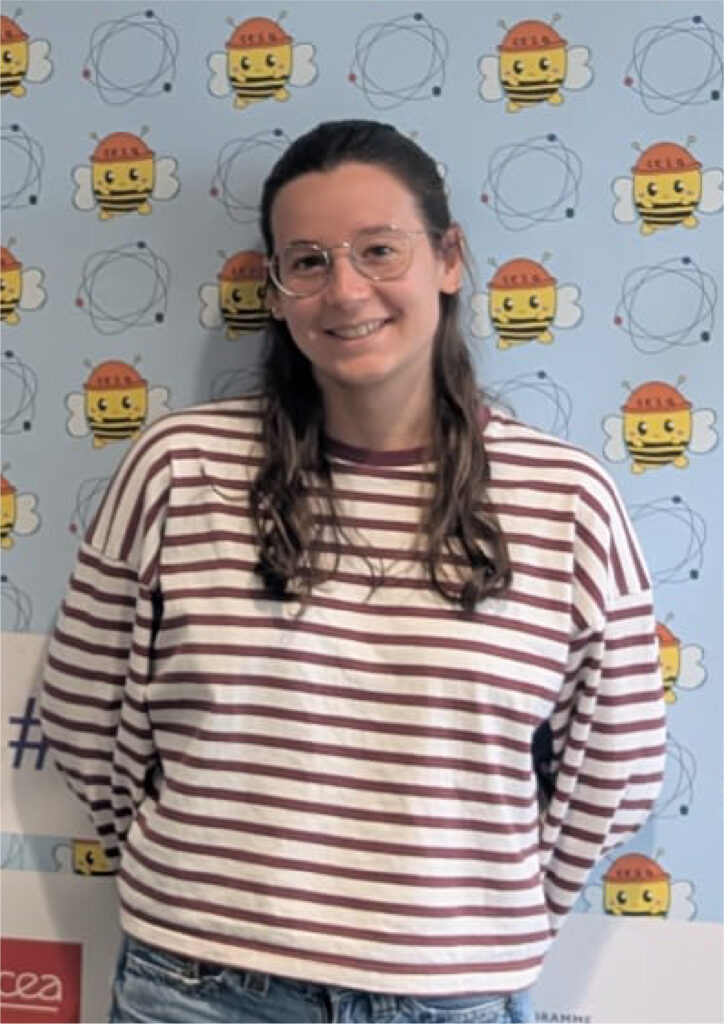
Just like Mar, who “says yes to any opportunity that comes to her hands” and registered to the event as soon as she saw the announcement in her local DigiQ discord channel. After her Master in quantum science of the University of Barcelona, her dream is to join a quantum software PhD in Europe, to “visit the world and learn other ways of doing research and other points of view”.
With her new-found group-mates and friends, she is tackling challenge n2, on the optimisation of water distribution using quantum algorithms.
“Most of us are physicists but there are also computer scientists and one person has studied AI. This is really interesting because maybe the physicists give a more theoretical approach to a problem but the computational and AI colleagues do amazing work with the code.”
More than the skills they developed during each challenge, this event has been a great opportunity for Adrae, Pijus and Mar to bond with people with a shared passion. “I’ve been to a lot of hackathons but this one, as we are all sleeping in the same hotel, it is giving us the opportunity to meet people from also other groups”. “It is really cool and we are making a lot of friends from all around Europe” says Mar.
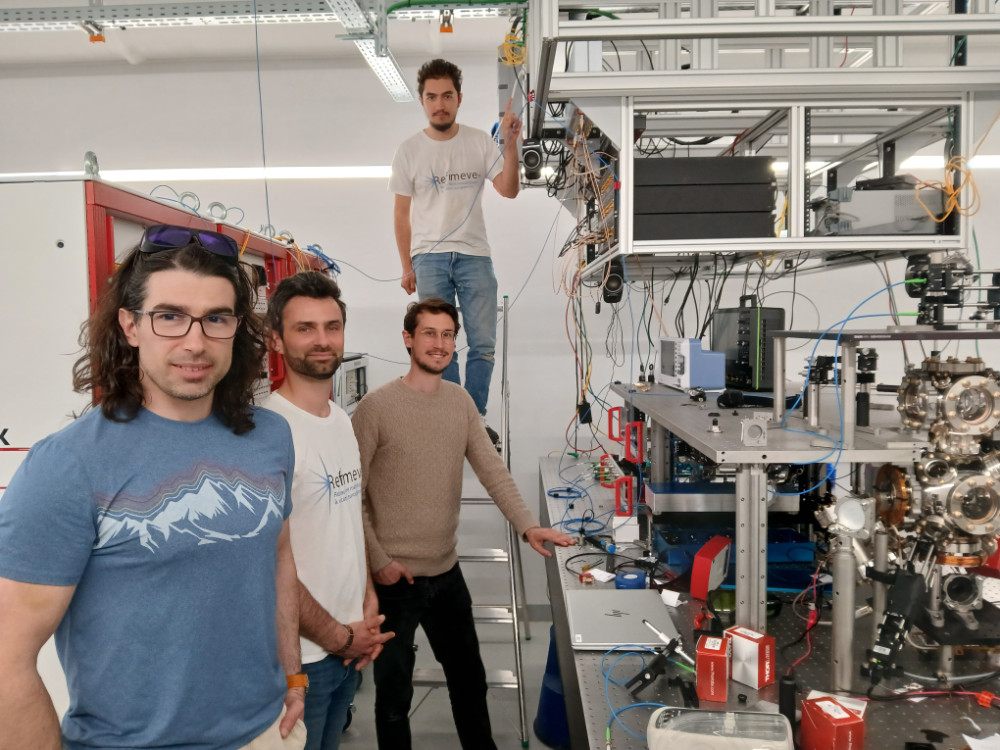
For Pijus this Hackathon is about “the friends you make along the way”, “good connections and a new insight into this interesting quantum world”. For Mar it was also the opportunity to bring home some hard skills: “I’ve never used QAOA before so now I have a new algorithm for my quantum software future.” Finally, Adrae will recall the visit of the laboratories at CESQ, a special opportunity for her.
CESQ is looking forward to welcome more quantum passionates like Adrae, Pijus and Mar to take on the next challenges of the Quantum Ideas Factory!
Antoine Pintart