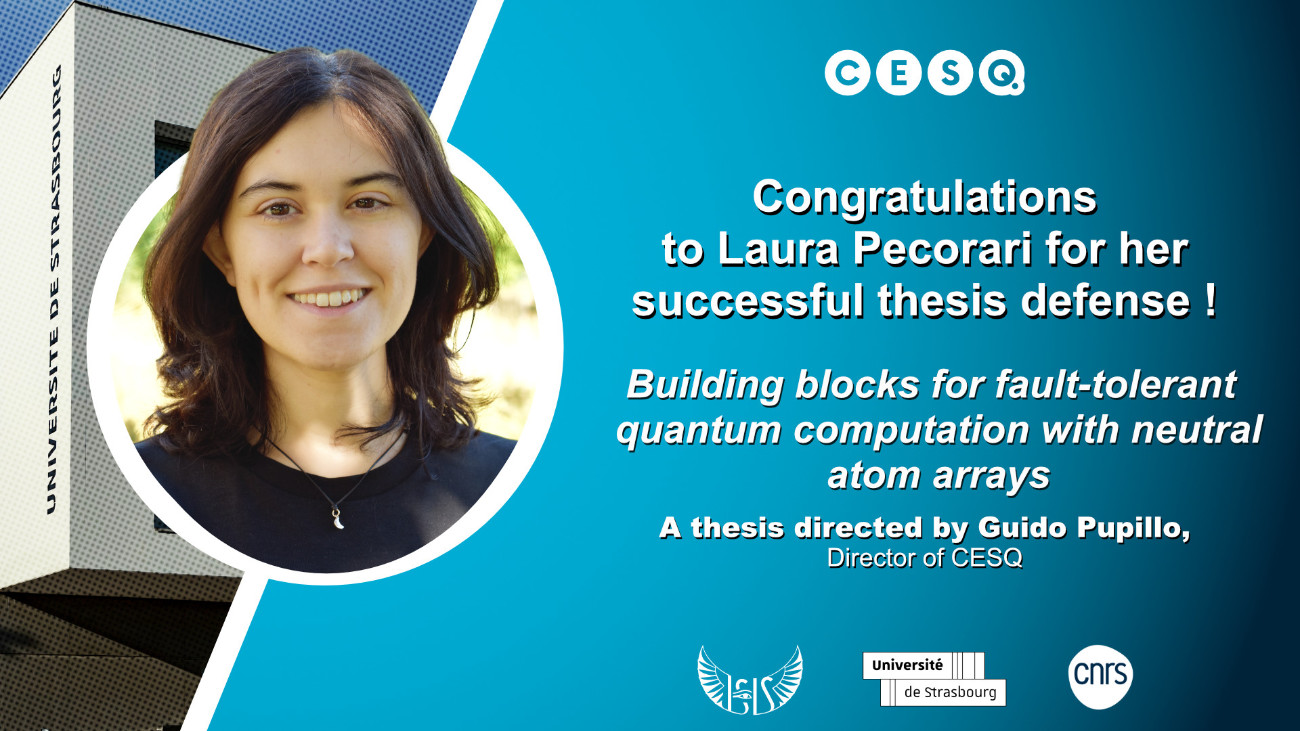
On Thursday 24 September, Laura Pecorari, PhD student in Guido Pupillo’s group, successfully defended her thesis titled “Building blocks for fault-tolerant quantum computation with neutral atom arrays,”. In it, she tackles one of the central challenges in neutral atom quantum computing: connectivity. Laura investigated the trade-off between qubit connectivity and experimental cost, aiming to store information more efficiently.
The challenge: long-range, all-to-all connections between distant qubits are extremely costly in both resources and runtime.
To address it, Laura developed the “La-cross codes,” a new family of quantum error-correcting codes that store more information per physical qubit than the standard surface code. She also demonstrated how these codes could be implemented on neutral-atom hardware.
Her work was supported by EuRyQa, QuantEdu France, and QMAT, and she received a mobility award from the Vinci Programme of the Université Franco-Italienne (UFI/UIF).
Laura joined CESQ after completing a Master’s degree in theoretical physics at the Alma Mater Studiorum – Università di Bologna, Italy, first on a pre-doc contract and then as a PhD student. As she moves on to the next stage of her career, we wish her continued success, and congratulate her once again on the excellent work achieved at CESQ.