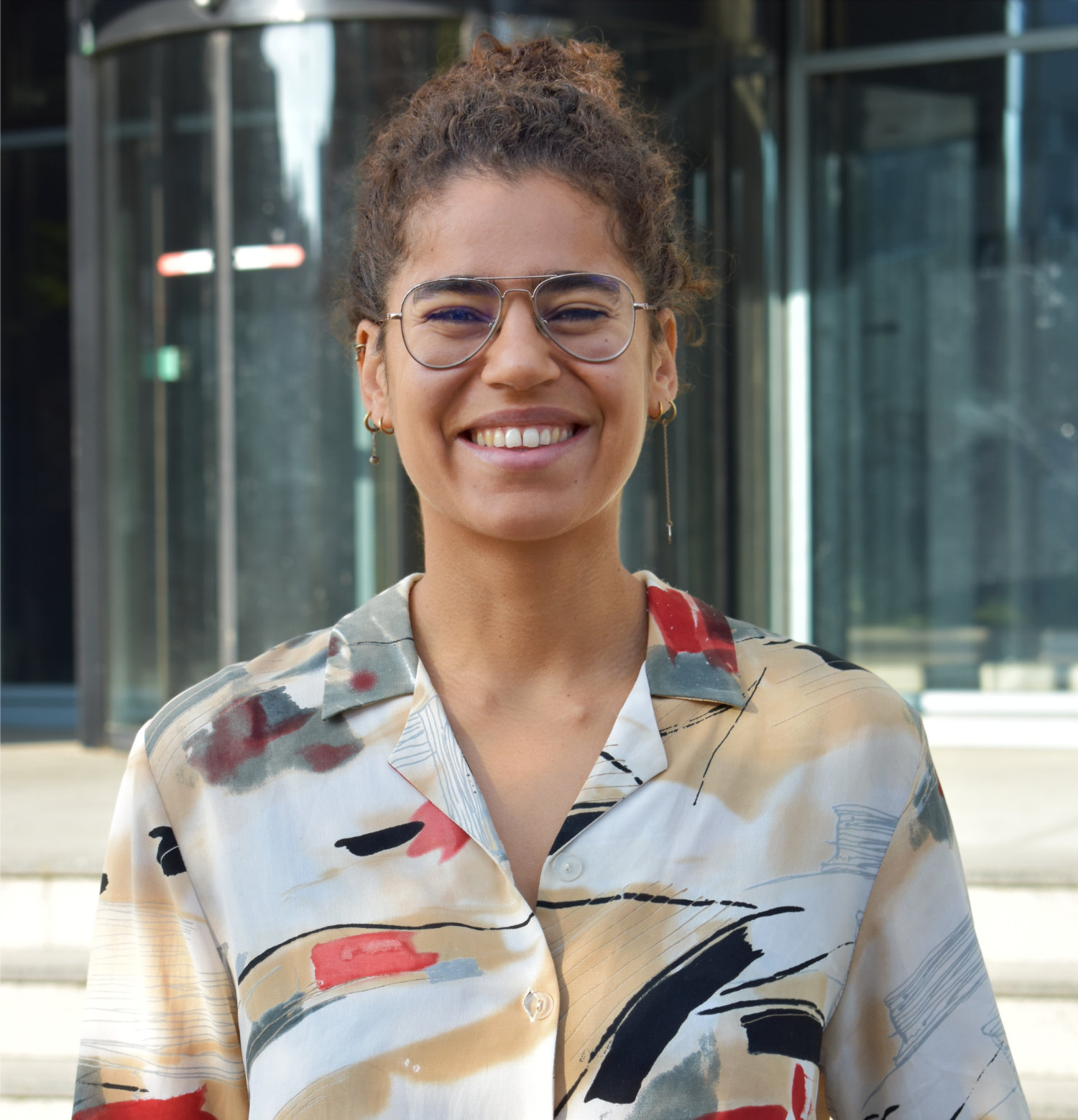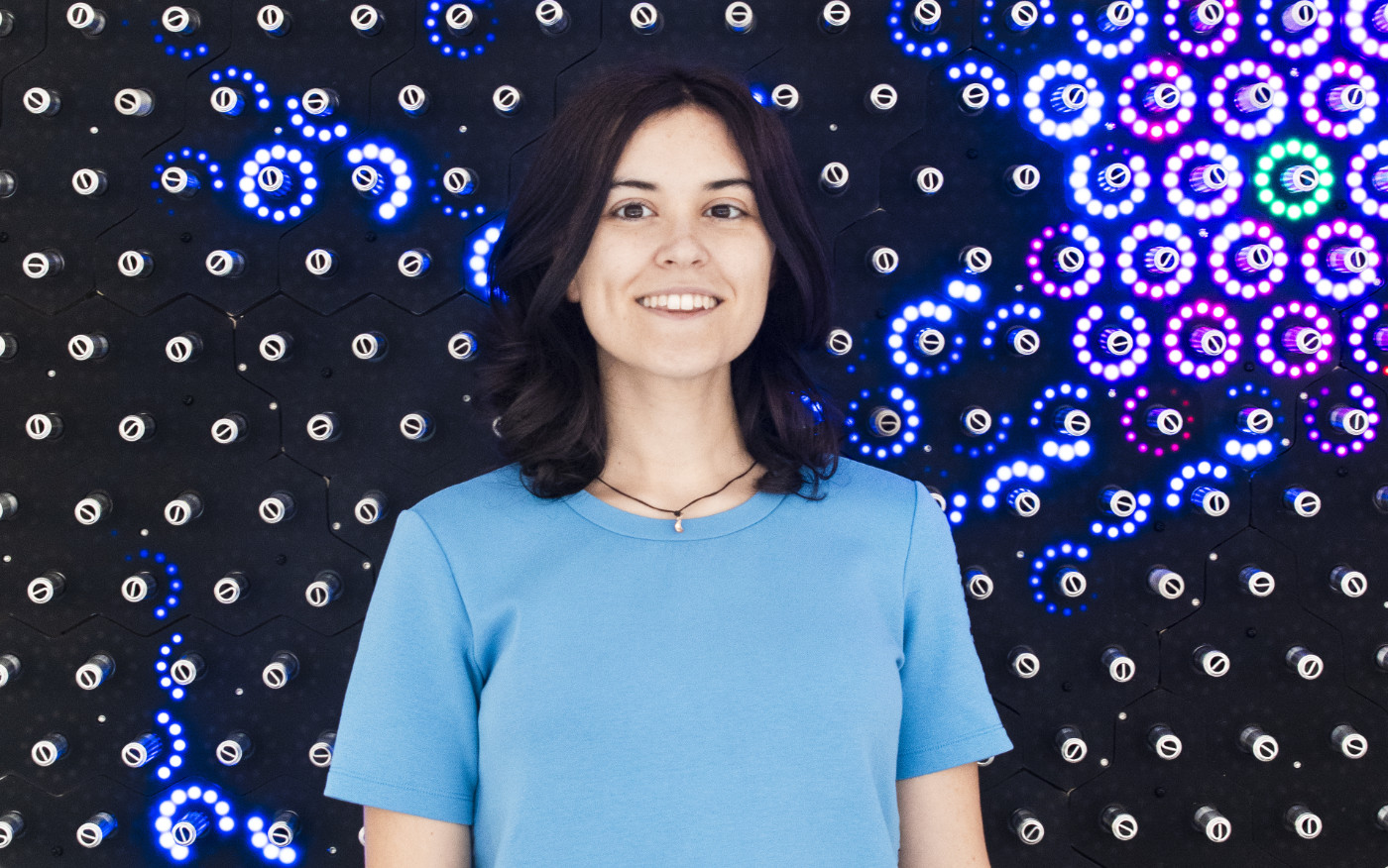
Research fellow at the CNRS, Salambô Dago joined Cyriaque Genet’s “Light-Matter Interactions in Complex Systems” team in February 2026 at CESQ and ISIS. Six months later, she reflects on her career path, her nanolevitation platform project, and what led her to join our center.
Salambô Dago: A trajectory between Lyon, Vienna, and Barcelona
After defending her Ph.D. in Information Thermodynamics under the supervision of Ludovic Bellon and Sergio Ciliberto at the ENS Lyon Physics Laboratory in 2022, Salambô Dago joined the Aspelmeyer and Kiesel group at the University of Vienna in Austria. Funded by a Marie Curie postdoctoral fellowship, she worked on feedback control of quantum suspended particles under the supervision of Nikolai Kiesel.
In 2025, she spent time as a visiting scholar in Orio Romero-Isart’s group at ICFO in Casteldefels Barcelona. There, she deepened her knowledge of macroscopic quantum physics theory. Wanting to secure a permanent position in France, she applied to CNRS in 2025 and moved to Strasbourg, joining the Institute of Supramolecular Engineering Sciences and the European Center for Quantum Sciences as a permanent researcher in Cyriaque Genêt’s team.
Unlocking the “Black Box” of Levitating Particles
The research led here by Salambô Dago aims to develop a nanolevitation platform capable of trapping particles and controlling their motion. The main challenge is to determine whether such objects, which are 1,000 times larger in diameter than atoms, can exhibit quantum behavior and how to control it.
Currently, when one seeks to trap a particle, there are two main ways to do so: in a liquid or in levitation. However, in a liquid, the particle is strongly damped by its environment. These strong classical interactions with the environment obscures any quantum properties. In levitation, under vacuum, the particle can be isolated while retaining its ability to move, allowing it to be controlled and its quantum properties to be exploited.
The problem, then, is determining what happens inside the particle. While we can study its motion, its internal properties, such as its temperature, remain in most cases inaccessible to us. One reason for this is the laser used to trap and measure the particle, which causes it to heat up internally. The problem is that in a vacuum, heat dissipates very poorly, and only glass particles can withstand it; however, this material offers few exploitable properties.
The project led by Salambô Dago aims to identify other materials, particularly photoluminescent ones, capable of emitting light after being illuminated. This property would provide an additional level of information about the particle’s internal state. Furthermore, some of these particles have the property of cooling down when illuminated with the right kind of light. With these additional levels of information and control, it would be possible to better understand what is happening internally. In the long term, we could be able to couple the internal state to quantum motion in order to move beyond linear behavior and pave the way for qubits.
Why join our center in Strasbourg?
What ultimately convinced Salambô Dago was, first and foremost, the subject of the research. “Where things really clicked with Cyriaque Genet’s team was the system being studied,” she explains. Accustomed to systems on the order of a hundred nanometers, she found a team of experts in small systems, stochastic physics, and noise control, a team already interested in levitating traps.
The environment did the rest. ISIS is well-versed in these systems, while
CESQ brings the expertise on quantum physics, particularly regarding cryostats through its collaboration with Arnaud Gloppe from IPCMS. Ultra-high vacuum and chemistry come from Éloïse Devaux, and particle synthesis from Loïc Charbonnière at the IPCMS. She also appreciates the particularly fruitful discussions with our experimentalists on equipment-related issues. As for the Strasbourg research ecosystem, she describes it as very dynamic, particularly in terms of funding opportunities, which facilitates the exploration of new ideas.
The construction of the nanolevitation platform is funded by a one-year grant from ITI QMAT. The GenQ project will also enable the recruitment of a doctoral student dedicated to research on calorimetry of levitating quantum particles.
We once again welcome Salambô Dago and look forward to following the progress of her projects at CESQ and ISIS.